Dolch vs. Fry sight words: choosing a starting point
Understand how to use Dolch and Fry word lists without turning them into a rigid reading sequence or a race through grade labels.
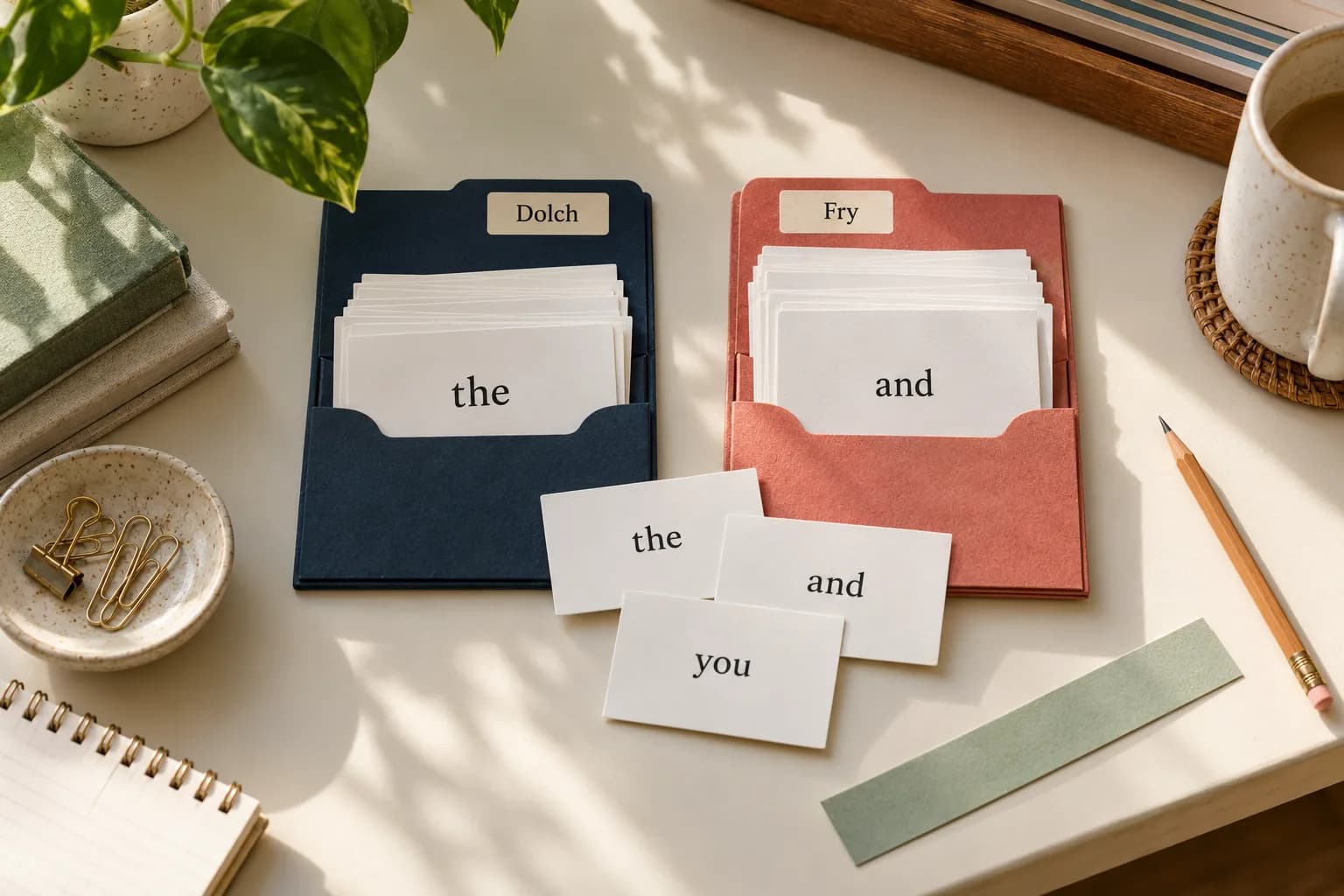
Use a word list to organize practice; use the learner’s taught phonics and current reading to choose the next words.
A list can make reading practice feel manageable: here are some common words to revisit. Trouble starts when the list becomes the entire reading plan. Dolch and Fry collections are useful organizers, but a child's position on a list does not describe everything they know about reading.
For a parent or teacher choosing between them, the practical question is usually simple: which collection fits the materials already being used, and which words are ready to teach next?
Keep one main organizer
If your school uses Dolch, use that organization at home so that conversations stay clear. If your homeschool materials use Fry, keep the same reference. You do not need to assign both collections simultaneously or ask children to relearn overlapping words in a different order.
Write down the exact words you are teaching this week. “We are working on these four words” is more useful than “we are behind on the second list.” It also makes it easier for another adult to help without adding unrelated work.
Check the word, not just the grade label
Before introducing a word, look at its spelling. Which letter-sound relationships has the child learned? Is there an unfamiliar spelling you need to explain? Can they understand the word when you use it aloud?
Consider two learners in the same grade. One might need more practice blending short words. Another might decode those words accurately but need work reading them smoothly in sentences. Assigning both the same long list would miss the difference.
Make a small working set
Choose a few words from the learner's current text or teaching sequence. Keep a simple page with three headings: teach together, practice independently, and revisit later. Move words according to what you observe, rather than after a fixed number of repetitions.
For example, a child who reads “and” readily in a card game but skips it in sentences needs connected reading. A child who confuses “was” and “saw” needs careful attention to letter order and sound-spelling relationships. Neither problem is solved by merely starting a new list.
Use Glow’s pathways thoughtfully
Glow's lesson grade groupings are teaching pathways. Browse them to find a suitable starting point, then adjust to the child's skills. A learner can revisit an earlier pathway without that becoming a judgment about their age or potential.
Keep explicit phonics, conversation, and connected reading alongside word practice. Review a few familiar words after a gap, including in ordinary print. The collection gives you an organized shelf; your observations tell you which book to take down next.
Sources & further reading
Research background and Glow’s approach, alongside the original activity ideas in this guide.