How to fade learning supports without removing help too soon
Move from models and prompts toward independent reading or math with small changes, fresh attempts, and a plan to bring support back when needed.

Reduce one support at a time, check what the learner can do, and restore useful help when the task needs it.
A support is useful when it helps a learner take a step they could not yet manage alone. Over time, you want to discover which parts of that help are still needed. Removing everything at once can create frustration; leaving every prompt in place can hide growing independence.
Think of fading as a series of small observations. You change one feature, invite an attempt, and use what happens to decide the next move.
Identify the support you are changing
Is the child relying on your spoken model, a completed example, counters, a highlighted spelling, or a step-by-step prompt? Name it before changing it. Otherwise, you may accidentally remove several kinds of help together.
For a reading task, keep the taught word and readable type while removing a colored background. For math, keep the same problem structure while asking the learner to choose when to draw a model.
Move from doing together to trying first
Demonstrate a task, complete another example together, then give a comparable fresh example. Invite the learner to start before you speak. Wait long enough for a strategy rather than immediately filling the silence.
If help is needed, provide the smallest useful prompt and notice its effect. “Where could you begin?” and a complete worked answer provide different amounts of support. Choose deliberately rather than escalating through a fixed script regardless of the child's response.
Keep assistance available
Fading does not mean forbidding tools. A number line, a reread, or a physical model may remain an appropriate way to solve a problem. The important question is whether the learner chooses and uses the support meaningfully.
When a task becomes too difficult, bring back a helpful model or simplify one demand. A child can need more support in a new context even after succeeding in a familiar one. That is a reason to inspect the task, not to erase the earlier progress.
Revisit the skill later
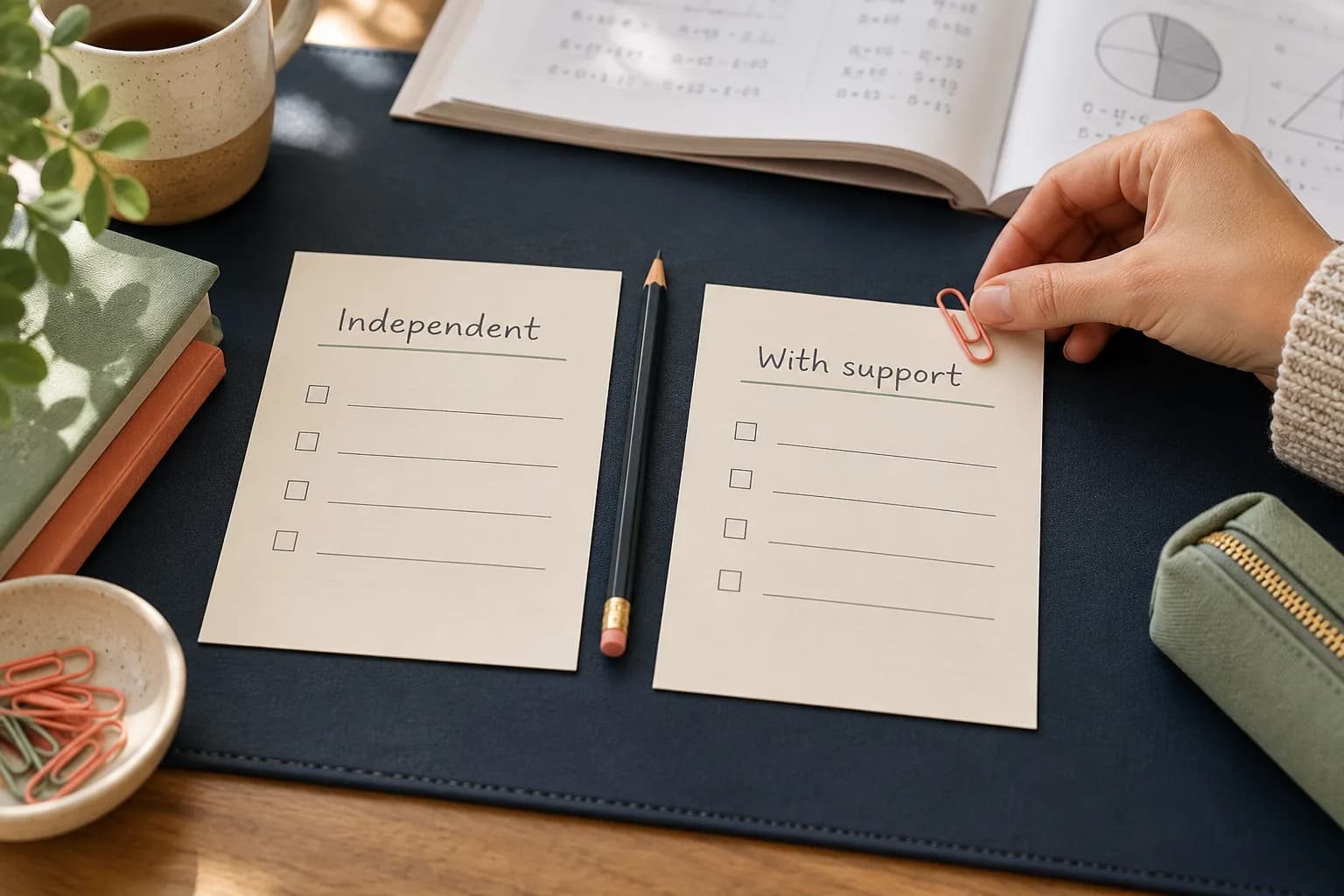
Check a similar example after a gap and record whether the first answer was independent. Then give feedback or help as needed. Keep those two moments separate in your notes.
In a lesson plan, write a practical next step: “Begin with one unprompted example; offer the ten-frame if needed.” This is more useful than declaring the child either fully independent or dependent. Good scaffolding changes with the task and the learner, leaving room for both support and a clear view of what the child can now do.
Sources & further reading
Research background and Glow’s approach, alongside the original activity ideas in this guide.