From colorful word cards to reading in ordinary print
Help children carry reading from familiar app cards into books and paper with a gradual, supportive routine for changing visual cues.

Keep the spelling and meaning familiar while changing the visual presentation, then check reading in ordinary print.
A child reads a familiar word on a colorful card, then hesitates when the same word appears in a book. That is a useful signal to vary the presentation. The goal is for the spelling to carry the reading, even when the background, font, or location changes.
Glow's white paper treats color as a cue that can support attention. It places that cue alongside explicit teaching, recall, feedback, and later practice. You can apply the same approach with a simple paper-and-screen routine.
Teach the word clearly first
Choose a word the child has been taught. Say it, discuss its meaning, and connect the sounds to the letters. If part of the spelling is unfamiliar, explain that part directly. Let the child build or write the word before reading it again.
A familiar colored card can be one setting for this work. The adult's explanation should still concern the letters and their sounds, rather than asking the child to remember that “the blue one” says a particular word.
Change one feature at a time
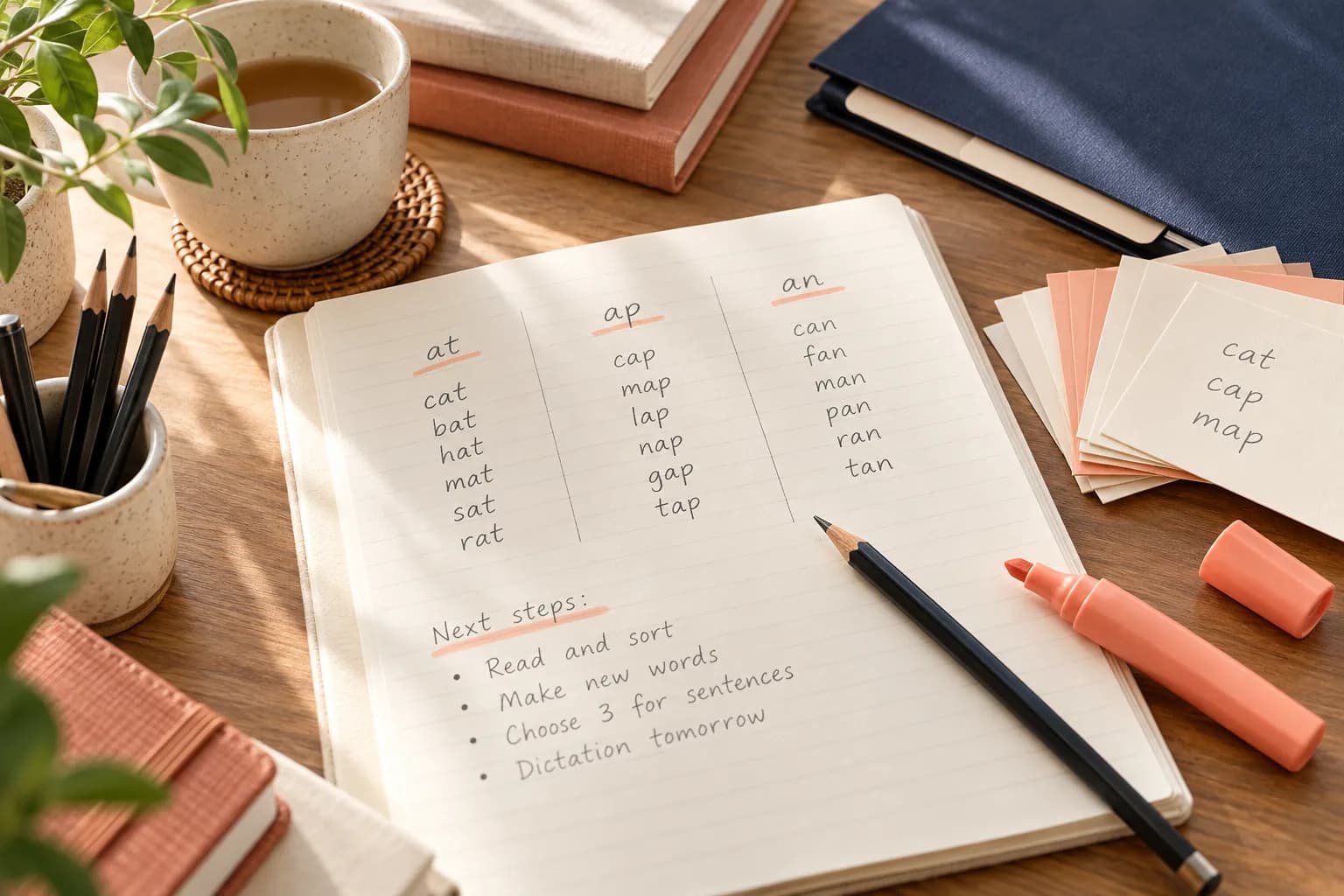
Show the word in dark print on a plain card while keeping the size and type style easy to read. Ask the child to read it. If they hesitate, return to the spelling and model as needed. Do not treat the changed format as a trick.
Next, place the word in a short sentence using other familiar material. Later, look for it in a different suitable text. Changing everything at once—size, spelling demands, sentence length, and layout—makes it harder to tell what caused a difficulty.
Try a small matching activity
Prepare pairs of the same taught word in two readable formats. Ask the child to read each before matching them. Include words that differ in a meaningful letter or spelling pattern, so that attention to the whole word matters.
Keep the activity brief and avoid speed pressure. You want to see whether the child can read the word, not whether they can remember where a card was placed.
Check again after a gap
Return to one or two words in ordinary print on another day. Note whether reading was independent or followed a prompt. If the child still needs the familiar card, keep teaching the sound-spelling relationship and use more small changes of context.
This is also useful for classroom handoffs. Tell families which words were taught and invite a plain-paper reread. They do not need to reproduce the exact app appearance. The transferable skill is the important part of the practice.
Sources & further reading
Research background and Glow’s approach, alongside the original activity ideas in this guide.