Teach make-ten addition with a ten-frame
Help children understand 8 + 5 and other sums that cross ten using counters, a ten-frame, and a clear bridge to written equations.
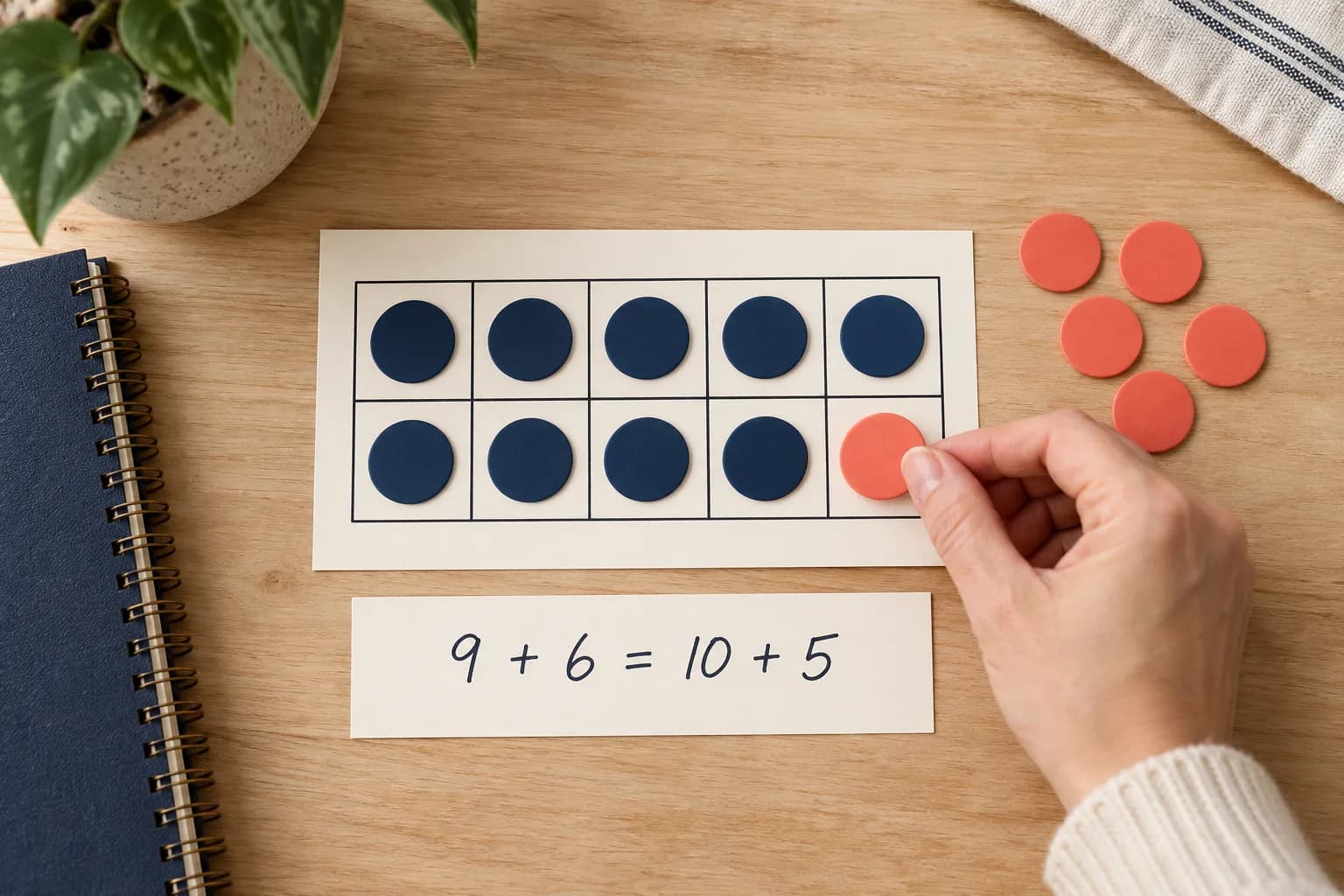
Move enough from one part to complete ten, then count what remains without changing the total.
“Make ten” is a useful phrase only when a child can see what is being made and why the total stays the same. A ten-frame gives the action a clear structure: fill the frame, then identify the extra amount.
Start when the learner can count small collections and recognize ten as a complete group. Use two frames or one frame with space beside it, plus counters large enough to handle comfortably.
Show eight and five
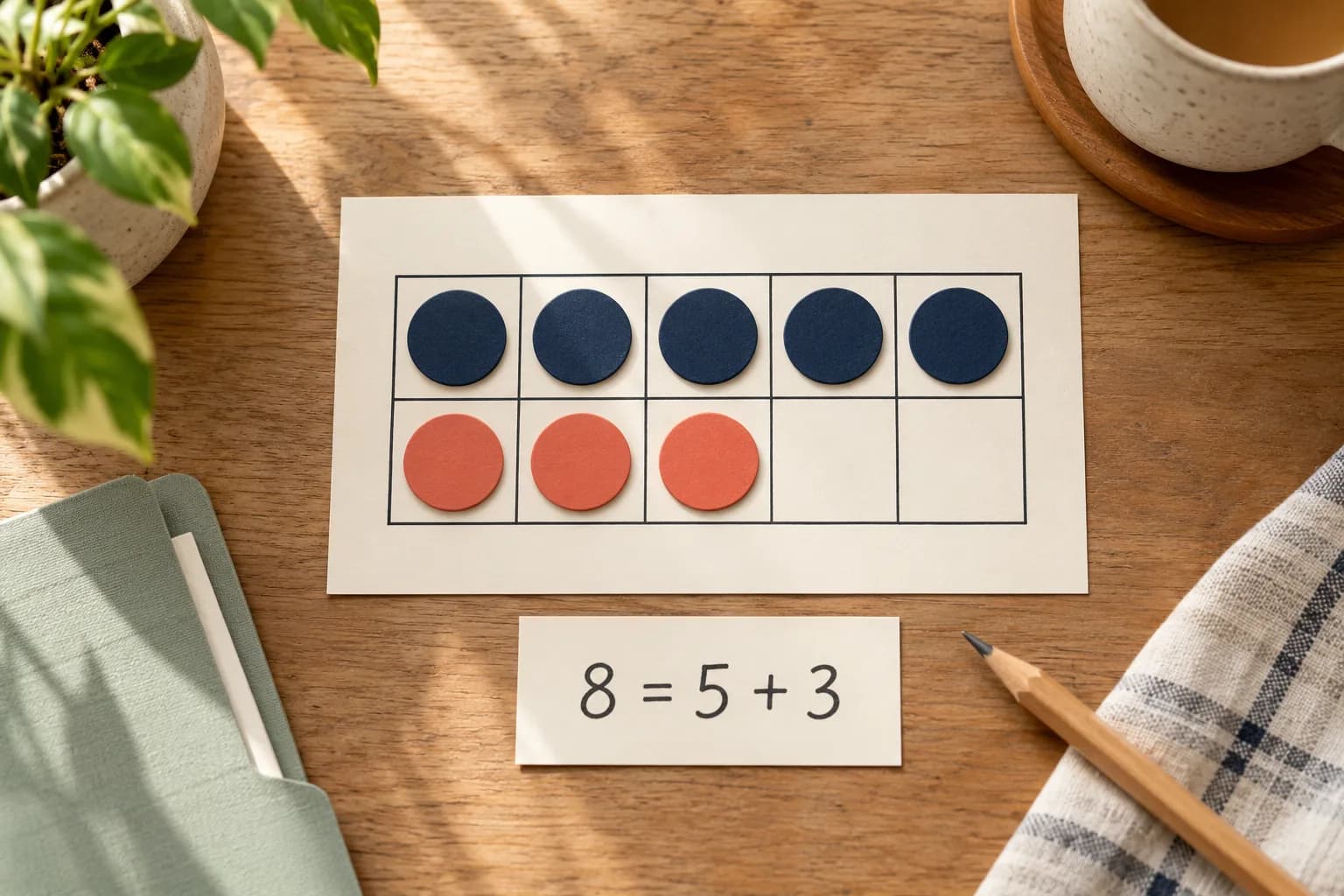
Place eight counters in the first ten-frame, filling one row of five and three spaces in the second row. Put five more counters beside it. Say, “We have eight here and five more. How many altogether?”
Ask how many spaces remain in the frame. If the learner cannot tell, count the empty spaces together. Move two counters from the group of five into those spaces. Now there is a full ten and three outside it.
Explain what changed
The counters moved, but none were added or removed. Ask the child to check that statement. You can move the two counters back, then forward again, to make the relationship visible.
Write 8 + 5, then 10 + 3, and finally 13. Explain that the five was split into two and three. Keep the equations close to the model so that the symbols describe an action the child has just seen.
Let the learner choose the move
Try 9 + 4. Ask how many counters would complete ten and how many would remain. Give the child time to move them before naming the answer. Then try a different example such as 7 + 5.
A learner who moves too many counters may need more work on the missing part to ten. A learner who moves them correctly but recounts everything may simply need more familiarity connecting ten and the remaining ones.
Make the model optional gradually
Invite a first attempt without counters after the strategy is understood. Ask, “What would you move to make ten?” Bring the frame back when it helps. Independent thinking can include imagining a model; it does not have to mean immediate recall.
Later, present the same kind of sum in a small story: eight books on a shelf and five more to add. Check that the child recognizes the addition relationship. Return after a gap with a new pair of numbers. The goal is a strategy that works beyond the exact arrangement used in today's lesson.
Sources & further reading
Research background and Glow’s approach, alongside the original activity ideas in this guide.