Part-whole thinking: a simple number-bond lesson
Use objects and drawings to help children split and recombine a whole, then connect number bonds to addition and subtraction.
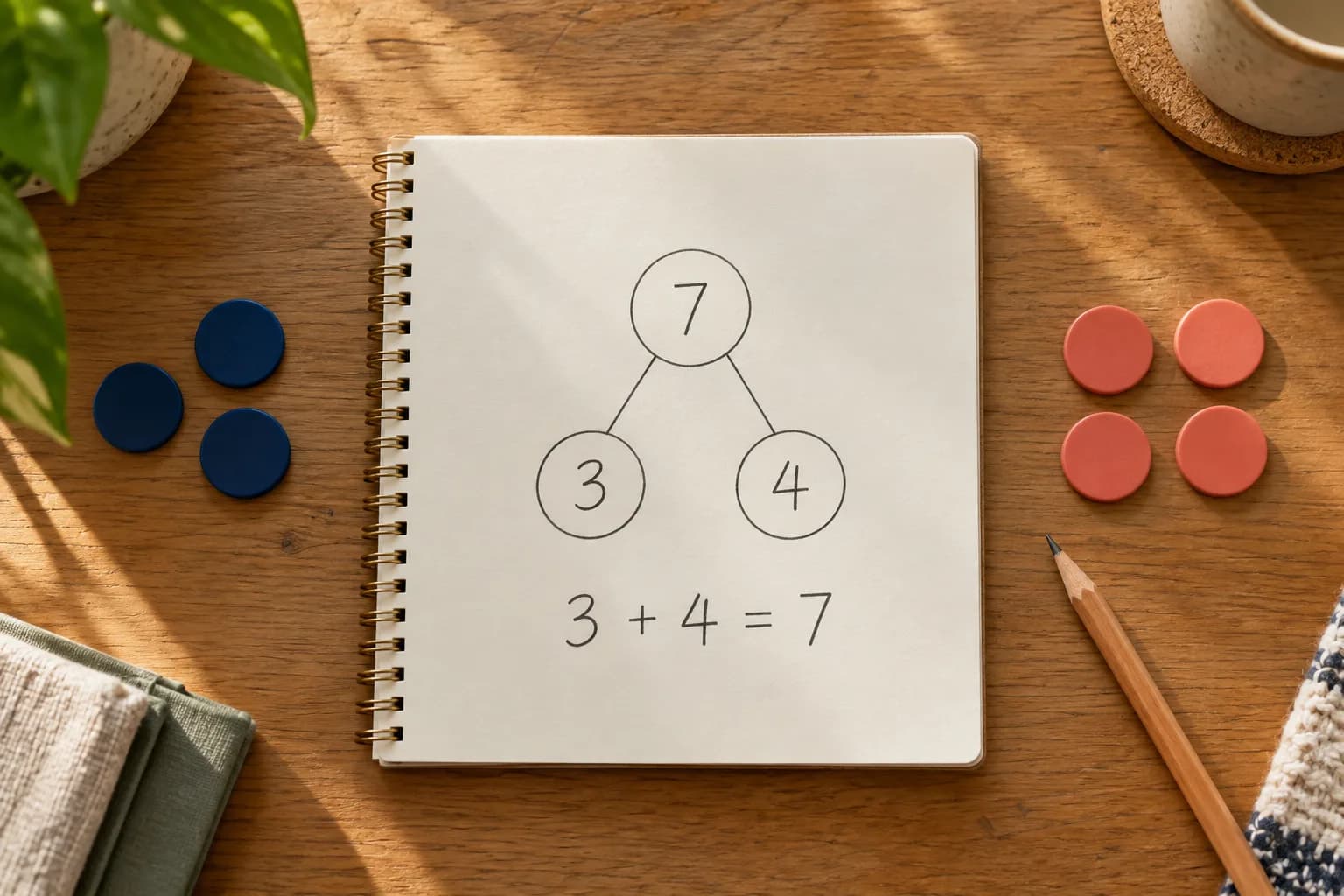
Keep the whole fixed while changing its parts, and ask the learner to explain how the pieces fit together.
Seven can be five and two, four and three, or six and one. Those relationships are more useful when a child has actually built them than when they have only filled in circles on a worksheet. Part-whole thinking begins with a collection and a clear question: how can we separate it while keeping the total the same?
Use a small number the learner can count reliably. Set out two paper circles for the parts and a larger area for the whole.
Split a real collection
Place seven counters in the whole area. Move some into each part circle. Ask the child to count both parts and confirm that there are still seven altogether. Bring the counters back together and try a different split.
Keep the language consistent: the whole is seven; these are its two parts. If the learner accidentally adds or loses a counter, pause and recount. The fixed whole is the relationship you are exploring.
Connect objects to a drawing
Draw a simple number bond with seven in the whole circle and the two part amounts in smaller circles. Trace from each part to the whole while describing the arrangement.
Then write the matching addition equation. For parts of five and two, write 5 + 2 = 7. Switch the positions of the parts and discuss why 2 + 5 still gives seven. The drawing and equation should describe the same collection.
Hide one part
Keep seven as the whole and show five in one part. Cover the other part. Ask how many are hidden and invite the learner to explain. They might count on from five, use a known relationship, or rebuild the collection.
Reveal the hidden counters to check. Connect this to 7 − 5 = 2 when the learner is ready. Avoid making the hidden part a rapid-fire game before the relationship is understood.
Vary the context
Tell a small story: seven children are choosing between drawing and building; four choose drawing. How many choose building? Let the learner model the situation and identify the whole and the parts.
Check a different whole on another day. If the child can fill in a familiar diagram but cannot tell you what its numbers represent, return to objects and stories. If they can explain several splits, move toward reasoning without rebuilding every time. The aim is a flexible understanding that supports later addition, subtraction, and missing-number problems.
Sources & further reading
Research background and Glow’s approach, alongside the original activity ideas in this guide.