Use number lines for addition and subtraction
Teach learners to connect direction, starting points, and jumps on a number line with addition and subtraction equations.
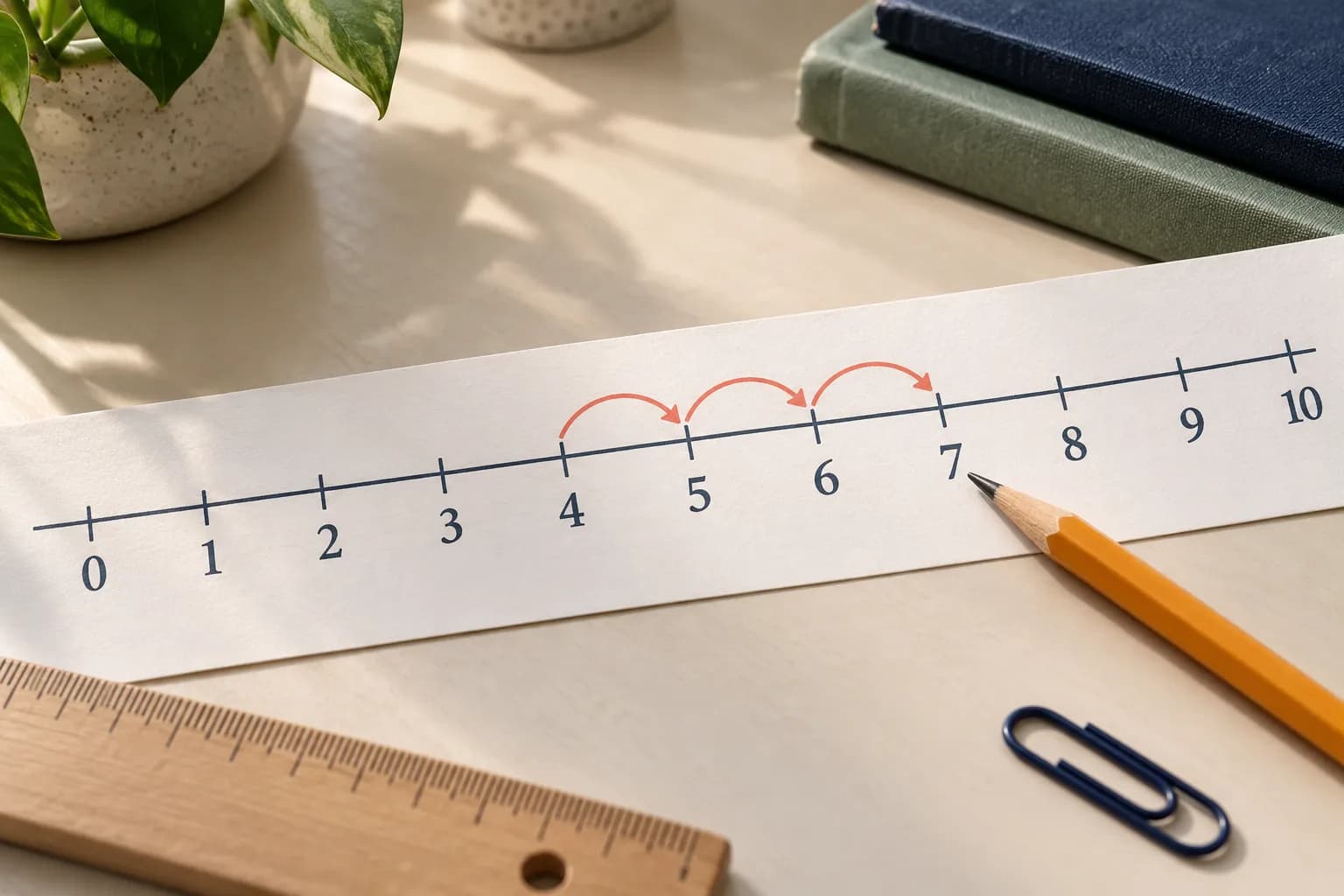
Name the starting number, describe each jump, and connect the movement to the equation.
A number line can make a calculation visible, but only if the learner understands what its marks and spaces mean. Before using one for arithmetic, explore its structure: numbers increase in one direction, equal steps represent equal amounts, and each labeled point has a position.
Begin with a short, clearly marked line. A crowded page with several scales can distract from the relationship you want to teach.
Establish the start
For 4 + 3, place a finger or marker on four. Explain that four is the starting amount. Make three one-unit jumps to the right, counting the jumps rather than recounting the starting point. Land on seven.
An easy error is to say “one” while still standing on four, then stop at six. If that happens, draw an arc for each movement. The number of jumps, not the number of points touched, represents the added amount.
Connect subtraction to movement
For 7 − 3, begin at seven and move three one-unit jumps left. Ask the child to explain why the direction changed. Use a simple story, such as having seven tickets and using three, to give the equation a context.
Compare the two journeys. Four plus three reaches seven; seven minus three returns to four. Let the child point to the matching endpoints rather than merely copying both equations.
Change the jump size thoughtfully
When one-unit jumps are familiar, show how two or five can be represented by a larger jump. Label the size of each jump and check that the drawn distances fit the scale. Three jumps of two represent six, not three.
For an older learner, try an empty number line with a stated starting point and labeled jumps. Explain that it records a strategy rather than providing every number in advance. A clear example is 28 + 7: jump two to 30, then five to 35.
Check whether the representation is helping
Ask the learner to tell you what the starting point, direction, and jumps each mean. If the line creates more confusion, return to objects or a simpler range and connect the two models carefully.
Later, give a new equation and let the child choose whether a number line would help. A successful lesson is not just a neat drawing. It is a learner who can use the drawing to reason, explain a result, or notice that an answer does not fit the movement they made.
Sources & further reading
Research background and Glow’s approach, alongside the original activity ideas in this guide.